
 Written by
 Samedi Valpic nr 8 – November 15 –
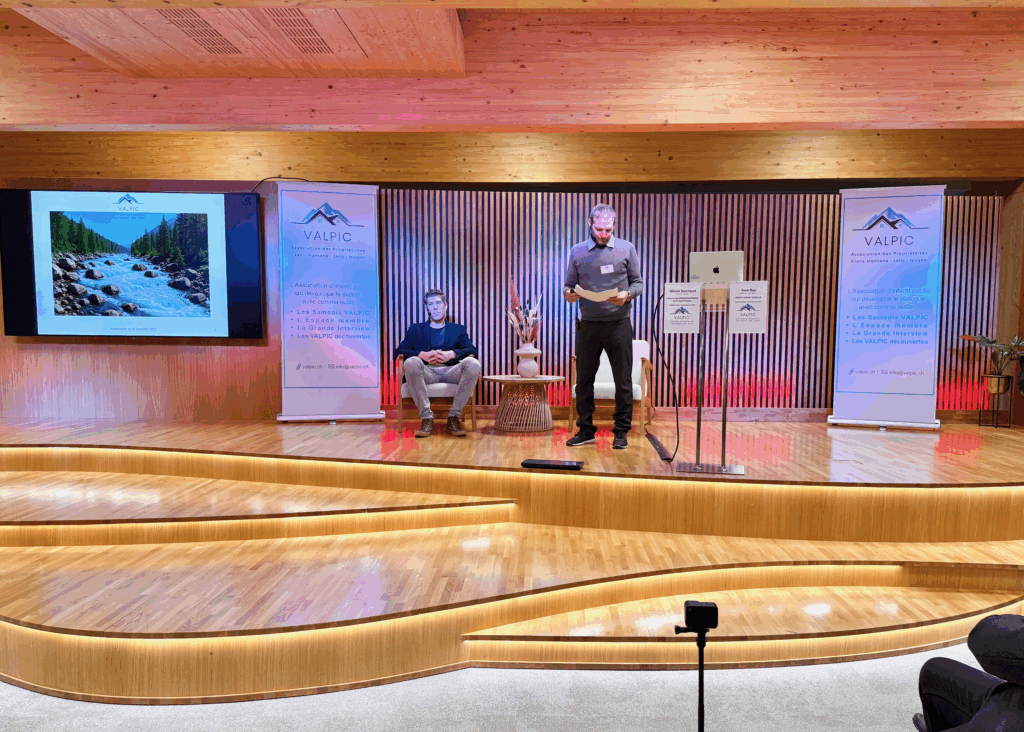
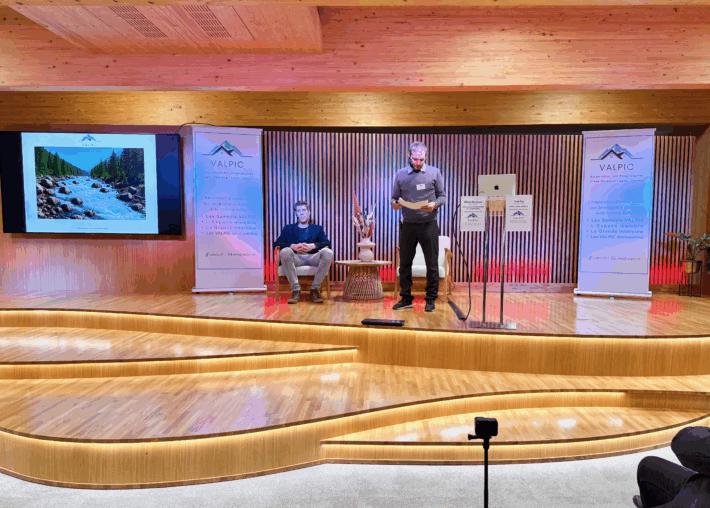
Yves Rey and Olivier Duchoud –
Samedi Valpic nr 8 – November 15 –
“Water and its infrastructures” and the long-awaited “Lienne-Raspille Project” took us to the heart of a resource that is slowly being tamed, but not yet completely.
Olivier Duchoud, President of the Intercommunale des Eaux du Haut-Plateau and President of Icogne, introduced us to all the labels that go with water, before Yves Rey, the project’s design engineer, took us through the ins and outs of the Lienne-Raspille project.
The labels
Olivier Duchoud showed us all the facets of water: the drinking water in our taps, but also the irrigation water that is essential for crops in our very dry mountain climate. Then there’s “commercial water”, used for watering golf courses, for mechanical snowmaking and for generating electricity through turbines.
While these waters complement each other, they also compete to a certain extent, as their uses must be partially arbitrated.
The raw figures would tell us that, in theory, all is well. On the production side, the Tzeuzier dam stores 50 million m3 and has an annual inflow (i.e. potential use) of 100 million m3. On the consumption side, the Haut-Plateau uses 3 million m3 of drinking water, 4 million m3 of irrigation water, 0.4 million m3 for artificial snowmaking and 0.09 million m3 for golf courses, i.e. some 7.5 million m3 per year, representing 7.5% of available supplies. So we’re swimming in opulence…
Not so simple…
In reality, the Haut-Plateau (Icogne in fact) has only 45% of the water inflow from the Lienne to the Tzeuzier, and most of this water is turbined to produce the 240 million KWh per year generated by the power plants downstream of the dam.
Added to this is the fact that resources on the eastern side (La Raspille) are irregular and less distributed, while the natural water storage function of the Plaine Morte Glacier (in the process of melting completely) has all but disappeared.
The answer
It was at this point that the Lienne-Raspille project, conceived by Yves Rey, came into its own. The idea was to capture water from the Raspille, Boverèche and Ertentse rivers and distribute it through the existing water networks, while reserving the surplus (stored in the recently doubled Chermignon lake, with a dedicated volume of 4 million m3 at Tzeuzier) for seasonal smoothing and turbining to generate electricity.
In terms of water, the completed project will distribute 8 million m3 of water (equivalent to all the water currently consumed on the Haut-Plateau, or, in other words, a doubling of water production capacity).
The “electrical” part of the completed project will generate 34 million KWh per year, equivalent to almost all the annual electricity consumption of households on the Haut-Plateau.
This gives a local annual production of hydroelectricity (totally renewable, it should be noted) of :
Tzeuzier: 240 million KWh (but Icogne only has 45% = 108 mKWh).
Lienne-Raspille: 34 million KWh.
For annual electricity consumption on the Haut-Plateau of :
Households: 36 million KWh
Public facilities: 64 million KWh
(shops, hotels, ski lifts, skating rinks, etc.)
With a positive hydroelectric production balance of 108+34-36-64 = 42 million KWh surplus, growth potential on the Haut-Plateau will seem assured, both in terms of water and 100% renewable electrical energy.
A detailed presentation is available in the “Valpic Saturdays” section of the Members’ Area.
NB: the figures quoted are rounded averages, intended to compare orders of magnitude.