
 Written by
Saturday, Valpic No. 16 – August 15, 2026 –
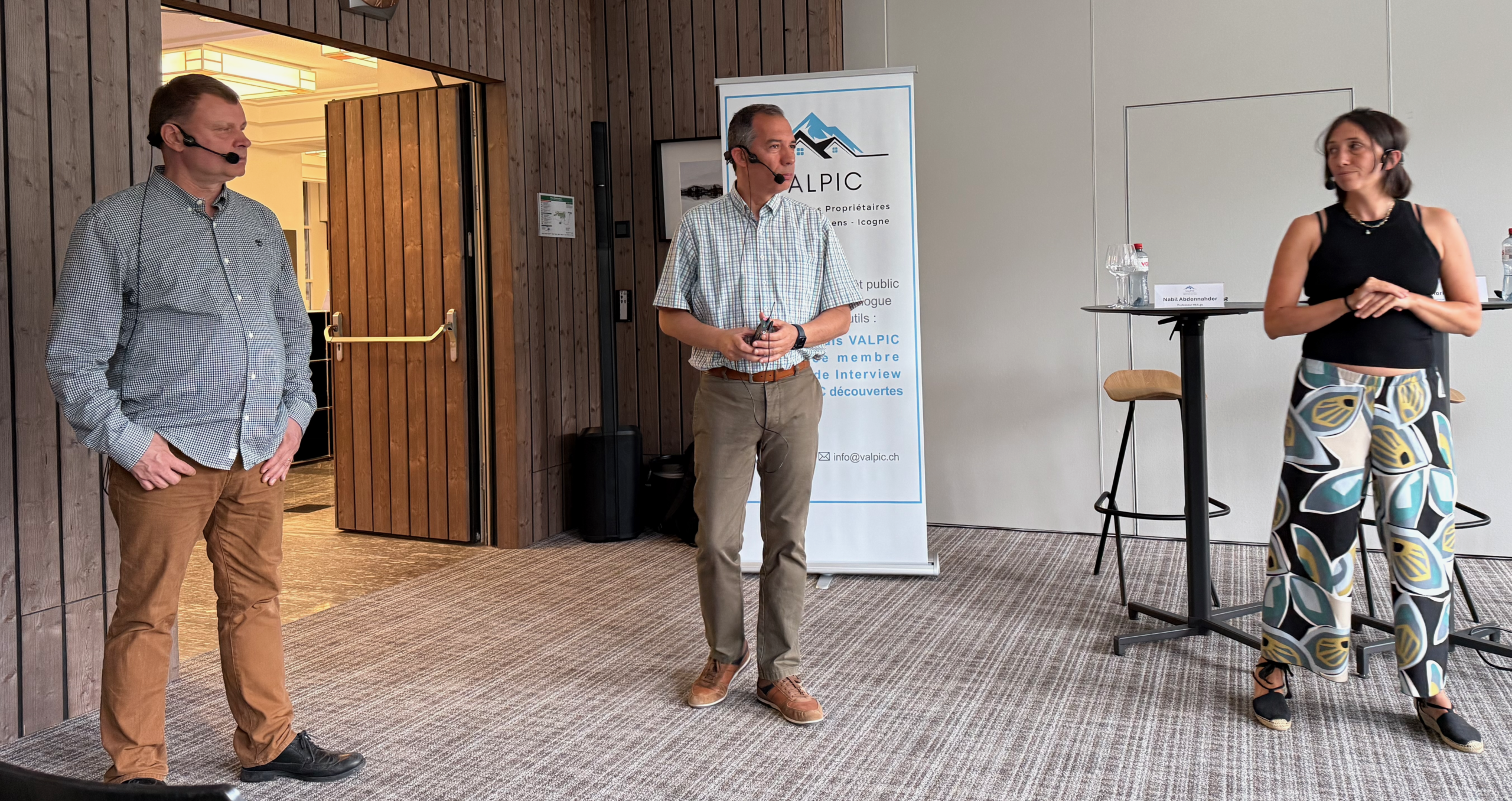
Prof. Emmanuel Fragnière – Prof. Nabil Abdennadher – Chiara Valerio
Saturday, Valpic No. 16 – August 15, 2026 –
Energy Prosumers in Mountain Destinations –
Social Acceptance and the Energy Transition –
Summary of the presentation and discussion with the audience –
Key Takeaways
The presentation puts forward a central idea:local energy communities cannot develop based solely on technical performance. Their operation also depends onresidents’ consent, their trust in the use of data, and their willingness to adapt certain habits. Social acceptance must therefore be a consideration from the very beginning of the design process, not only after the equipment and operating rules have been finalized.
Researchers are presenting studies that combine solar power generation, batteries, electric vehicle charging, and demand response. The proposed systems aim to betteralign power generation with consumption,particularly by shifting certainusesto more favorable times. The research focuses as much on forecasting and control tools as on the conditions under which users accept their intervention.
The discussions reveal, however, thatsupport for the initiative is not yet assured. Several participantsare asking for assurances regardingconfidentiality, the protection of individual freedoms, costs, and concrete benefits. Others question the advantages of a shared system compared to a standalone installation for a single-family home. The issue of transitioning from voluntary participation to a potential requirement comes up repeatedly.
The most detailed example involves the laundry room of a housing cooperative. It shows that asolution deemed simple by engineers—such as an app that suggests when to do laundry—canrun up against community rulesthat residents hold dear. The fieldwork, therefore, involves designing a solution that is compatible with these rules, rather than treating resistance as a mere lack of information.
The session presentsongoing researchand prototypes, not a finished system with definitively established results. It concludes with a proposal to continue the dialogue and organize workshops with interested communities. No deployment decisions were made by the audience during the meeting.
The Setting of the Meeting
This Saturday’s Valpic recording was made on August 15, 2026, and has a running time of 1 hour and 48 minutes. The introduction takes up the first few minutes; the researchers’ presentation begins around 00:05:04, and the public Q&A session begins around 01:42:32. Comments from the audience are woven throughout the presentation, giving the session the format of a discussion-based presentation rather than a lecture followed by a separate question-and-answer session.
The host introduces the concept of the “prosumer,” that is, someone who both produces and consumes electricity. He uses the example of households equipped with solar panels and explores the transition from individual installations to a networked system: who participates, what rules apply, how can people cooperate with their neighbors, and what happens in the event of a conflict?
The project team combines expertise in energy, risk analysis, digital technologies, and usage studies. Its work is part of several European Union projects that include pilot studies in Switzerland. Tourism, residential communities, and local communities are key areas of application for this presentation.
The Shift from Consumer to Producer-Consumer
Time stamp in the recording: 00:05:04 to 00:15:10.
Researchers describe ashift in the consumer’s role. In the traditional model described, consumers use electricity from the grid and pay their bills. In the proposed model, they can also generate, store, share, and adjust their demand. Their role is therefore no longer limited to choosing a quantity of electricity:they participate in the operation of a local system.
Demand managementis an essential component of this shift. It may involve delaying a load of laundry, changing the time a vehicle is charged, or adjusting certain equipment based on available generation capacity. The user plays anactive role in coordinatingthe community’s needs, its production capacity, and its interactions with the grid.
The speakers highlight the limitations of the model that involves installing solar panels primarily to generate profit by selling excess electricity. They believe that the economic expectations raised by this model have not always been met. The addition of batteries and the potential use of vehicles as storage solutions open up new possibilities, but also make the system more complex.
Regulations and pricing structures are also described as difficult for the general public to understand. The researchers advocate for simplified procedures, local support, andgreater citizen involvement. They view this approach as serving several goals: the energy transition, keeping bills under control, increased self-sufficiency, and a reliable energy supply.
A comparison with the industrial sector illustrates the desired change. The presentation contrasts a standardized production system—imposed from the top down—with anorganizational structure better suited tousers’needs. From this perspective, communities are not expected to all operate in the same way: the tools must take into account their specific constraints and choices.
What Social Acceptance Encompasses
Timestamps in the recording: 00:16:08 to 00:18:43 and 00:23:43 to 00:28:31.
A question from the audience prompted the researchers to clarify the scope of acceptance. It is not simply a matter of endorsing the energy transition in general. Rather, itinvolves accepting smart microgrid technology, its measurements, its forecasting capabilities, and certain impacts on daily life.
There are two distinct dimensions. The first concernstechnologyand data: installing equipment, measuring usage, enabling forecasts, and potentially placing orders. The second concernshabits: being willing to reschedule an activity or to let an automated system take over part of the control. A person may be open to one of these aspects but reluctant to accept the other.
The speakers emphasize thatthis approach must be taken early on. Trying to convince residents after the system has already been designed risks provoking resistance. Conversely, engaging with them from the outset makes it possible to understand what is acceptable, what is not, and what requires adjustments.
When asked about the level of acceptance needed for the development of these systems, a researcher cited current low acceptance rates and a potentially higher tipping point. These figures are provided verbally without a precise definition of the population, scope, or measurement method. Therefore, they do not allow for the establishment of a validated threshold for success. The key question remains how tomove from a few volunteers to broader participation.
The collective dimension is acknowledged:an energy community requires interaction, rules, and mutual trust.It is not merely a technical connection. Researchers use examples from neighborhoods and laundry rooms to show that seemingly minor difficulties can influence how the system is actually used.
Energy Infrastructure and Flexibility
Timestamps in the recording: 00:17:08 to 00:25:24 and 00:37:45 to 00:41:29.
The device is described in practical terms as a unit equipped with sensors and connected to electrical equipment. It is designed to collect measurements, forecast consumption or production, and then assist in decision-making and the control of devices. A prototype developed with a partner company is presented; the speakers mention that it runs on Linux and measures voltage and current.
Applications include, in particular, solar panels, batteries, heat pumps, household appliances, and charging stations. Forecasts can cover future demand and times when local production will be higher or lower.Their purpose is to help determine when to consume, store, or exchange electricity.
According to researchers, the growth of decentralized generation poses a coordination challenge. If many generators feed their surplus power into the grid simultaneously, the grid must be able to absorb these flows. They outline two basic approaches: strengthening infrastructure or making better use of flexibility to limit peaks and shift certain loads.
Flexibility here refers to the ability to adjust the timing or level of consumption—or even production. The examples given include postponing a machine cycle, temporarily adjusting the heating, or charging a vehicle. Financial incentives are mentioned as a way to compensate for certain efforts.
Technical reasoning is thus based on forecasting, but this requires information about usage patterns.It is precisely this connection that fuels the debate: the data needed for optimization can alsoreveal private habits.The system’s performance and its acceptability are therefore presented as interdependent.
Data Protection and Freedom of Choice
Timestamps in the recording: 00:18:43 to 00:33:57 and 00:46:21 to 00:57:34.
The issue of data is quickly becoming one of the main topics of discussion. The moderator asks where the data goes, who can access it, and for what purposes it may be used. He distinguishes between the benefits of voluntary behavioral changes andthe risks of widespread surveillance of the population.
Opinions in the room are divided. Some participants point out that a great deal of information is already shared online and question whether energy data is particularly sensitive. Others believe that meter readings can reveal whether someone is home, their schedule, or their habits, which justifies specific safeguards.
The researchers explain that the granularity of the measurements plays a role in the information that is available. They mentiondata aggregated by quarter-hour intervalsin certain systems, in accordance with regulatory requirements. However, the discussion does not provide a complete and definitive description of the security architecture of the system presented. The responses remain primarily focused on theneed to address these issues withinthe project.
Several speakers asked what guarantees that participation is voluntary. One participant expressed concern that insufficient participation could lead to the measures becoming mandatory. The moderator elaborated on this concern: if access to an essential service depends on mandated equipment, refusal becomes practically impossible.
The researchers respond by emphasizingcivic engagement, an experimental approach, and user involvement from the design phase onward. They acknowledge, however, thatthe relationship between the energy transition, constraints, and democracy raises a fundamental question. No comprehensive legal mechanism for consent, withdrawal, or control over data usage was presented during the session.
The moderator suggests an approach: beyond securing the data, prohibit and penalize its use for purposes unrelated to energy management. In particular, he cites the risk of administrative or tax-related use that could reveal a person’s place of residence. This idea is discussed as a proposed safeguard; it is not presented as a rule that has already been adopted.
The host also illustrates how it’s possible to change one’s habits through his sailing experience. On board, he explains that he scheduled energy-intensive activities for times when energy was available. His remarks suggest that a change in behavior can be feasible, while remaining distinct from accepting intrusive data collection. He acknowledges that professional and family obligations on land can make these adjustments more difficult.
Research Projects and Swiss Field Sites
Time stamp in the recording: 00:33:57 to 00:46:06.
The speakers contextualize their method within a series of research projects. They describe a European consortium bringing together academic partners, companies, and energy providers, with several pilot projects in different countries. The goal is to test both the technologies and the social conditions for their use in a variety of contexts.
In Switzerland,several types of sitesare highlighted: school buildings and cooperatives in Geneva, tourist facilities and ski lifts in Valais, a neighborhood in Fribourg that combines commercial and residential uses, as well as electric vehicle charging stations. The diversity of these sites should make it possible to study different needs and opportunities for flexibility.
The Polygone cooperative in Geneva holds a special place. Researchers there work with residents who are already aware of collective and environmental issues. They note that installations in private spaces are limited to a small number of apartments where residents have volunteered to participate, while other initiatives involve public or common areas.
This clarification addresses a question from the audience regarding which neighborhoods were included in or excluded from the pilot programs. The speakers do not present the selection of sites as an overall ranking based on their level of acceptance. Rather, they describe a phased approach using prototypes, with initial volunteer participants who may then share their experiences.
In a hotel, the measures are distributed across specific areas, such as the lobby and dining areas, while the guest rooms are grouped together behind a shared system rather than being individually equipped. Economic considerations and concerns regarding the privacy of these spaces are raised.
The scope of this research remainsexperimental. The initial participants are not presented as representative of the entire population. The team is specifically seeking to expand its collaboration to other residences and communities in order to test its approaches in situations that are less familiar or less favorable at the outset.
Individual Self-Consumption and Pooling
Time stamp in the recording: 00:48:19 to 00:55:31.
One participant advocates for a different priority: developing home-scale systems—with solar panels and batteries—and then drawing power from the grid when the storage is depleted. He describes an example in which electric vehicle charging and household uses are powered by energy stored during the day.
In his view, this solution offers several advantages: ease of management, individual autonomy, and fewer issues related to data sharing or neighborly relations. He askswhy we should add a collective organizationif a significant portion of the needs can be met at the household level.
The researchers respond that not all households have a roof, a space, or the necessary resources to invest in individual storage. Shared storage is particularly aimed at people living in apartments and situations where resources can be shared. They also point out that a system may produce a surplus that its owner cannot fully store.
The possibility of using vehicle batteries is referred to as V2G, which stands for the transfer of energy from the vehicle to the grid or for local uses. The speakers present this function as a potential component of collective organization, rather than as something that conflicts with self-consumption.
The participant maintains that the individual should be encouraged alongside the collective. The discussion does not conclude with a demonstration of the universal superiority of any one model. He highlights the importance of the type of housing, the cost of equipment, the need for storage, and the desired level of cooperation.
Finally, the host raises a cost-related concern: the benefits of storage must be evaluated over its useful life, taking into account battery replacement and facility maintenance. No comprehensive comparative analysis is presented to help decide between the options.
The co-design method with residents
Timestamps in the recording: 00:57:34 to 01:08:05 and 01:13:51 to 01:15:29.
The method described here begins with the residents’ needs, practices, and concerns. Researchers conduct interviews and workshops, explain the technical possibilities, and discuss what participants are willing to share or change. This initial phase is primarily qualitative.
Communities are not considered interchangeable. A cooperative committed to shared principles of sustainability does not have the same expectations as a private apartment building, a neighborhood, or a tourist resort. The speakers emphasize the importance oflocal contexts, which they consider to be decisive factors that go beyond broad cultural or national categories.
Based on these discussions, the team develops scenarios, user journeys, and possible interfaces. The goal is to make the implications concrete: how will users receive information, what choices will they have to make, when, and under what constraints? The proposals are then tested in a real-world context and adapted based on the observed reactions.
Education plays an important role. Researchers have found that energy consumption and energy mechanisms are difficult to visualize. Energy bills are often easier to understand than energy flows or power ratings. Explaining the options is therefore part of the job, though it does not replace listening to people’s preferences.
Prototyping must also take into account existing equipment. At Polygone, residents have a tablet and want to integrate certain functions into it. Its location—which isn’t necessarily close to the washing machine—becomes a practical issue: an interface may seem logical on paper but turn out to be inconvenient in practice.
The team proposes to conduct workshops with other interested groups as part of its research, with no fees charged to participants. This proposal opens up the possibility of collaboration; it does not constitute a commissioned service or a commitment on the part of the venue.
The Polygone Laundromat as a concrete example
Time stamp in the recording: 01:04:17 to 01:08:05.
The example of the laundry room illustrates how a collective preference can call into question an initial technical solution. The engineers propose a phone notification indicating when to do laundry. The residents respond by advocating for free access, which is an important rule of their organization.
In particular, they prefer to maintain certain informal coordination methods, such as waiting until the end of a cycle to find out if a machine is available. The app and notifications are therefore not automatically seen as an improvement. Their introduction may alter a way of living together to which residents are attached.
The discussion then turns to thepossibility of preserving individual choice while encouraging collective behavior. The researchers describe a scenario in which users could use the machine immediately by accepting the corresponding cost, or let the system choose a time that is more favorable to the community.
This second option involves trusting the system and accepting a delay. Residents may view this as a gesture of solidarity, provided that their essential demands have been taken seriously. Researchers report that the relationship improved once these expectations were acknowledged, following discussions that were at times tense.
The lesson here is twofold: optimization must respect the customs that shape the community, and commitment must be sustained. The speakers thus raise the question of the sustainability of social acceptance. Agreement at the outset does not guarantee that it will persist after several months, particularly in cases of tension between neighbors.
Tourism Practices and Vacation Constraints
Timestamps in the recording: 00:58:50 to 01:02:10 and 01:15:29 to 01:20:49.
Researchers distinguish between habits at home and expectations while on vacation. Someone who is mindful of their usual consumption habits may be less willing to follow a schedule or change their activities during a vacation. The research therefore focuses onthe acceptability of constraints in specific situations,rather than on a supposedly constant ecological attitude.
One scenario involves charging electric vehicles. If all charging spots are occupied, the visitor must make a reservation, wait, or return to move their vehicle. This process may conflict with their desire to hit the slopes early or stay out on the slopes. The test aims to determine which constraints remain acceptable in this scenario.
A second scenario focuses on the speed of ski lifts when ridership or available capacity is low. The researchers are examining skiers’ reactions to adjustments in service. One participant noted that users are already subject to certain operational restrictions without being consulted, which led to a discussion of the difference between an existing practice and a change that is explicitly subject to their approval.
Spa hours, the maintenance of certain slopes, and food service are other examples. One speaker described a facility that revised its extensive daytime food service offerings to reduce power consumption by offering simpler alternatives at certain times.
These examples are either scenarios under discussion or reports of local experiences. They do not constitute an adopted program to reduce tourism services. The goal is to assesshow adaptation can be understood and experienced, and whether it is compatible with the expectations of visitors, second-home owners, and businesses.
Expected Gains and the Limitations of Quantifying Them
Timestamps in the recording: 01:09:01 to 01:13:51 and 01:25:23 to 01:32:26.
The facilitator explicitly asks what the benefit is of switching from standard operations to optimized operations. This question sparks a discussion not only about the expected improvement percentages but also about the nature of the metric being considered. Several figures are mentioned, but there is no sufficiently clear common basis for them to be accepted as a proven result, although a difference of 15% in order of magnitude was cited.
To understand the exchange, we must distinguish between three objectives.
- The first is to reduce the total amount of energy consumed.
- The second is to reduce the bill, particularly by shifting usage to less expensive times.
- The third is to reduce power peaks and the strain on the grid. An improvement in one of these areas does not automatically mean an equivalent improvement in the others.
One participant emphasized this difference between the amount consumed and the amount billed. Later, the researchers and a panelist in the audience pointed out thatshifting electricity consumption throughout the day is a key objective.Infrastructure must, in fact, be able to handle peak loads, not just the annual volume of electricity used.
The comparison with energy-efficient building renovations is also raised. The moderator asks how behavioral and digital gains compare to those from insulation. The researchers respond that technical performance alone is not sufficient to predict actual usage: comfort, habits, and personal needs can account for a discrepancy between theoretical savings and observed results.
The session does not allow for the establishment of a single savings rate, a return-on-investment timeframe, or a quantified assessment of the pilot projects. The percentages mentioned are based on objectives, estimates, or verbal comparisons, the scope of which is not always specified.
Pricing and Leverage Points for Behavior Change
Time stamp in the recording: 01:25:23 to 01:32:26.
One participant described the two-tiered pricing structure as a tool that is already easy to understand and use freely. She explained that she adjusts certain devices to take advantage of the cheaper rates without needing any complex controls. This comment raises the question of the added value of the new systems compared to simple practices.
The researchers respond by referring todynamic pricing announced in advanceand tailored to expected conditions. They believe that this information can enable more precise optimization. The moderator then asks whether the additional benefit justifies the constraint or the perceived loss of freedom.
The debate also highlights that peak periods shift as solar production changes. One speaker pointed out that a surplus of electricity can occur during the day, and that the challenge then becomes finding ways to utilize that excess generation. The reasoning, therefore, is not limited to systematically shifting consumption to nighttime.
The host then raises the question of how demand responds to prices: Can households really cut back on essential uses when rates go up? The discussion does not result in a measure of this sensitivity. Instead, the researchers discuss “nudges”—or behavioral prompts—to encourage adjustments without relying solely on price.
Solidarity, information, convenience, and ease of use thus emerge as factors that complement financial incentives. The public nevertheless emphasizes the need to make the individual benefit understandable and tangible.
Environmental Constraints and the Future of Projects
Time stamp in the recording: 01:20:50 to 01:40:31.
One participant asked whether climate constraints and the increasing scarcity of certain resources would ultimately force changes, regardless of users’ consent. She envisioned a future in which consumption restrictions would make the issue of consent less central.
Researchers acknowledge the significance of this question without claiming to resolve it. They distinguish their work—conducted at the laboratory and community levels—from broader policy decisions that may become necessary.The tension between environmental urgency and respect for rights remains unresolved.
The European Union’s BRIDGE initiativeis presented as a platform for coordination among projects, particularly those focused on civic engagement. Speakers describe working groups, the sharing of results, and the production of reports or guidelines. The stated goal is to pool knowledge and facilitate the use of innovations beyond the scope of individual pilot projects.
The public also questions the cost of these programs and how the funding is used. Researchers distinguish between the budgets for the various projects and those for coordination activities, but the discussion does not provide enough information to determine a reliable total amount or its breakdown. One participant stated that he was not convinced by the explanations provided.
Regarding the next steps in the work, the researchers point out that these are innovation projects that carry a risk of failure. They are currently in the prototyping and pre-commercialization phase: the goal is for companies to be able to adopt certain solutions, with no guarantee of uniform adoption across all regions.
The session concluded with expressions of gratitude and an invitation to continue the discussion. Interest in the technical possibilities coexists with persistent reservations about their political, economic, and social implications.
Conclusions and Open Questions
The main contribution of this presentation is tohighlight the human dimension of energy flexibility.The examples show that optimization can affect comfort, schedules, freedom of choice, trust, and neighborly relations. The proposed co-design approach aims to integrate these dimensions from the outset and to test solutions in their real-world context.
Thepublic’s objectionshighlight several conditions for participation:
- specify the data collected and how it is used;
- keep the options clear and easy to understand;
- explain the benefits and costs;
- adapt the system to the type of home;
- and demonstrate that pooling resources offers an advantage over simpler solutions.
Several questions remainunanswered:
- which governs the community and settles disputes;
- how a participant can withdraw;
- What safeguards prevent the secondary use of data;
- how to share profits and investments;
- and how to maintain engagement beyond the initial group of volunteers.
Energy and financial results will also need to be evaluated separately, using defined metrics. Reducing consumption, lowering peak demand, and saving on utility bills address different challenges. The presentation outlines the objectives and research methodology but does not yet provide the information needed to validate an overall assessment.
The proposed approach involveslocal pilot projects, which are discussed with users and then adapted before potentially being rolled out on a larger scale. The meeting shows that this rollout will depend as much on the credibility of the rules and the benefits as on the sophistication of the equipment.
Speakers:
Prof. Emmanuel Fragnière ( HES-SO Valais-Wallis)
Prof. Nabil Abdennadher (HES-SO Geneva)
Chiara Valerio (HES-SO Geneva)
Host: Jean Metz