
 Written by
 Samedi Valpic nr 10 – February 21, 2026 –

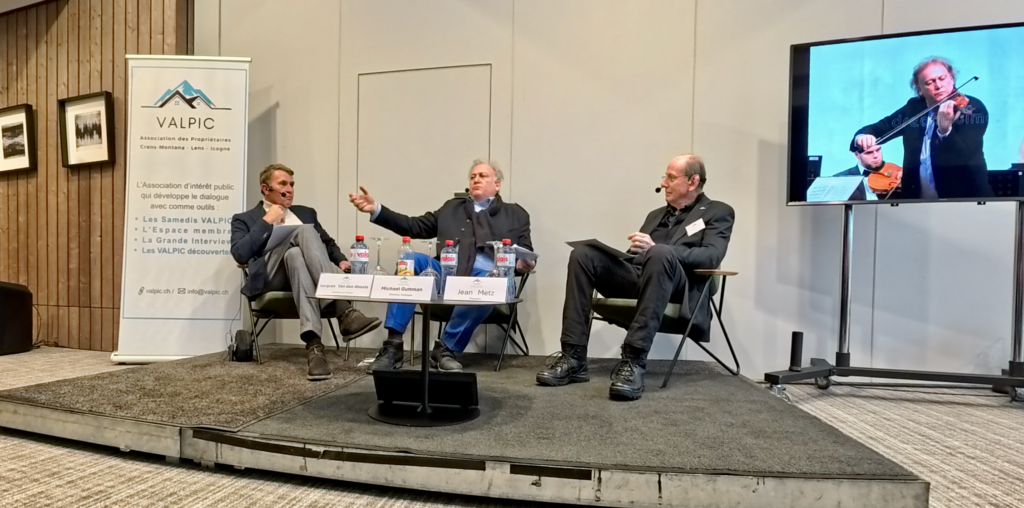
Michael Guttman interviewed by Jacques van den Abeele and Jean Metz
Samedi Valpic nr 10 – February 21, 2026 –
“10 years of Music Festivals” is also about the attractiveness of our estates through a quality cultural offering, and this was the theme of this TV set with our guest Michael Guttman answering questions from Jacques van den Abeele and Jean Metz in front of a large audience interested in finding out more.
Michael Guttman, violin prodigy at the age of 10, concert artist, soloist and conductor who has performed on the world’s greatest stages, now devotes much of his time to the artistic direction of numerous international festivals, including Crans-Montana.
Why has he chosen to take up residence at this major celebration of classical music on the Haut-Plateau, and what artistic direction has he chosen for an audience that includes many of our members and owners?
Michael Guttman revealed his guidelines:
Extended seasonality
Unlike standard 10-day formats, the Crans-Montana Festival covers all 4 seasons. This approach avoids post-event oblivion and maintains continuous cultural activity. It also makes it possible to tailor programming to a specific audience at each period: international in February, local in September. Temporal continuity reinforces cultural anchoring.
The refusal of dogmatism
Michael Guttman rejects imposed themes (e.g. L’Eau, L’Amour), which he sees as an artistic straitjacket. He prioritizes freedom of transformation for each individual concert. “My aim is to surprise rather than to educate in a didactic way”. Flexibility takes precedence over thematic coherence, which is often artificial.
Popular roots
Michael Guttman reminds us that classical music has its roots in folklore (Mozart, Chopin, Bartok). He argues in favor of decompartmentalizing to make music lively and accessible, without losing its nobility. “Classical music is merely a sophisticated evolution of popular music.
The Communion of Silence
For Michael Guttman, music also serves to create silence and introspection, a form of spiritual nourishment. The “live” experience is irreplaceable by digital means, thanks to the physical vibration of the instruments. The concert becomes a necessity for collective listening, which then resembles a ritual ceremony.
The Present Moment
Confronted with history and the future, Michael Guttman recalls the present moment, evoking a comparison with skiing: the obligation to be 100% in the moment, without thinking about the past or the future. For him, the connection with the audience is a tightrope: the artist physically feels whether the audience is “with him” or “loses it”. Interpretation is a constant risk-taking in the “here and now”. The stage demands absolute mental presence.
Michael Guttman’s message is clear: the true essence of classical music lies not in the past, but in creating a silent communion in the present, where artist and audience share an organic vibration that cannot be digitized.
When the meeting adjourned, most of the audience moved on to the next room to attend the piano duo concert by Katia & Marielle Labèque, in partnership with Crans-Montana Classics.