
 Written by
Saturday, Valpic No. 14 – July 14–18, 2026 –
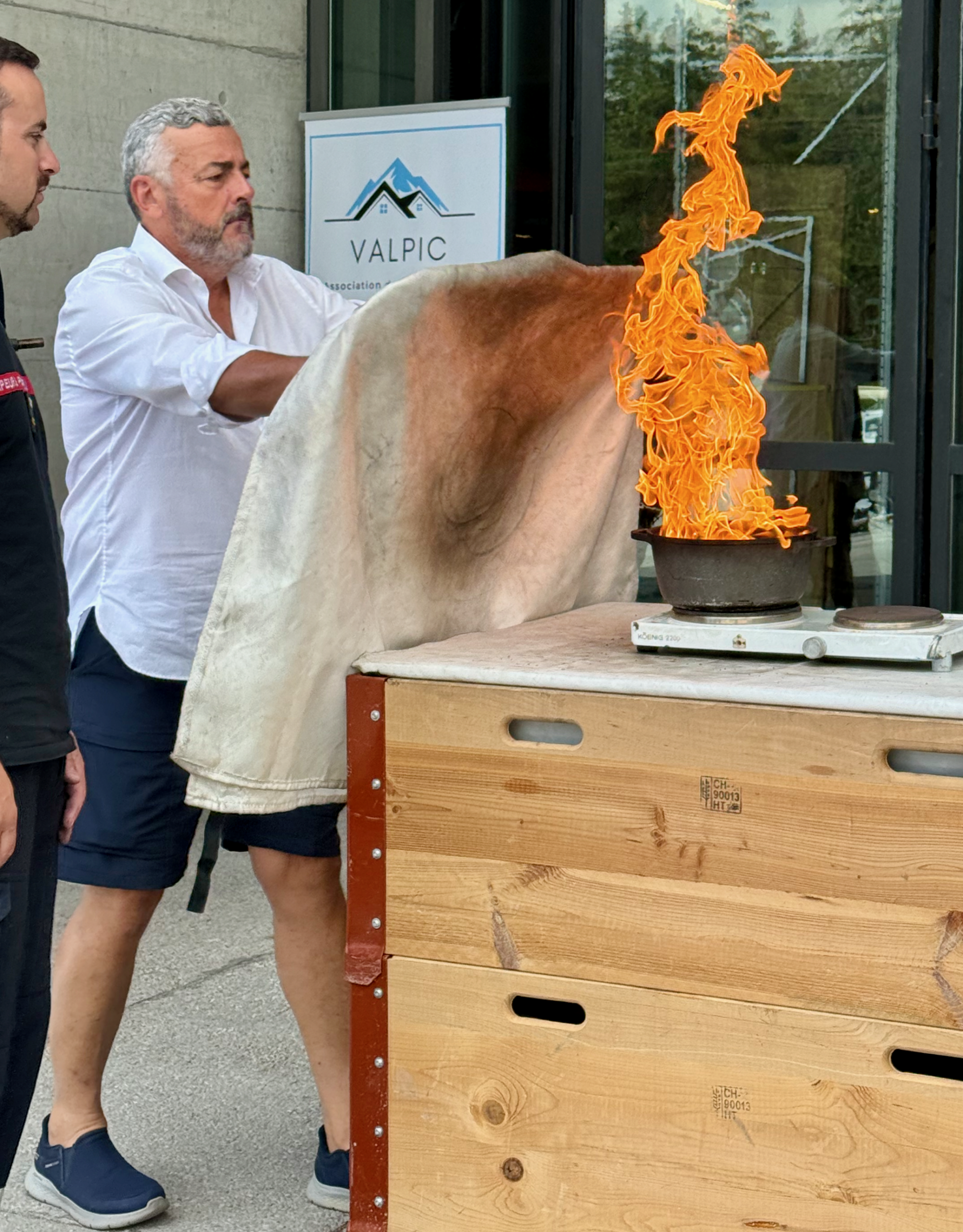
Fred, a Valpic member, at work with his fire safety instructor –
Saturday, Valpic No. 15 – August 4, 2026 –
Fire Safety and Emergency Response Training
Overview of the emergency response center’s organization, its missions, and the response procedures applicable within the three municipalities.
1. Background and Objectives
David Vocat, Commander of the Crans-Montana Rescue and Fire Department, presents the organization and missions of the rescue center, which serves the three municipalities. The session aims in particular to outline:
- the center’s structure and operations;
- alert and response procedures;
- the available human and material resources;
- training for participants;
- the main risks encountered;
- coordination with other emergency services.
2. Organization of the rescue center
The center serves three municipalities. Its staff consists almost entirely of volunteer firefighters, unlike some departments that employ professional firefighters.
Its organization is based, in particular, on:
- a command;
- a fleet manager responsible for managing a fleet of approximately 19 vehicles;
- a training coordinator;
- a system of day, night, and weekend on-call shifts.
The daily on-call team usually consists of three people who can be called in within about ten minutes. At night and on weekends, five people are on call.
Reinforcements are deployed based on the nature and severity of the incident. As a general guideline, a yellow alert may require the mobilization of 15 to 25 people, while a red alert may require the mobilization of between 45 and 50.
A reorganization is being considered to consolidate the vehicles at two sites and expand the main fire station. This change is expected to improve response times, vehicle fleet management, and operational efficiency.
3. Status of Volunteer Firefighters
Volunteers receive compensation for their service. The first hour is paid at a rate of approximately CHF 50, and any additional hours are paid at a rate of approximately CHF 30. On-call periods are also compensated, at a rate of, for example, approximately CHF 360.– per week.
However, recruiting and securing volunteers remains a challenge. Some employers are reluctant to allow their employees to participate when it requires them to work during regular business hours.
The lack of incentives—particularly tax incentives—comparable to those in other countries or regions was also noted.
4. Equipment and Specialized Teams
The center has a variety of vehicles and equipment suited to the missions entrusted to it, including:
- hydraulic extrication equipment;
- equipment designed for hydrocarbon fires, including foam extinguishing systems;
- heat shields;
- equipment designed for electric vehicle fires;
- specific covers and equipment that allow for the use of large quantities of water.
Several specialized groups can be hired:
- extrication teams;
- lifeguards and divers;
- a helicopter-deployed team that has received specialized training;
- teams trained to respond to wildfires;
- professionals trained in the care of exotic animals, in coordination with the county veterinarian.
Available water sources—reservoirs, lakes, swimming pools, and irrigation points—are inventoried and mapped. This inventory helps prepare for responses to forest fires or fires in hard-to-reach areas.
5. Emergency Alert Procedures and Rescue Coordination
Emergency calls are routed to the appropriate dispatch center, which coordinates and dispatches the necessary resources. The European emergency number 112 can be used, subject to network coverage limitations.
During an incident, operational command varies depending on the nature of the event. In particular, the police may take charge of the response to secure a site, for example, during a traffic accident.
The incident commander and the command post then coordinate between:
- the fire department;
- the police;
- paramedics;
- medical services;
- helicopter companies;
- the other relevant partners.
Inter-municipal solidarity is essential. Available resources can be shared among several fire departments, in accordance with existing regional agreements.
6. Major Risks and Prevention Messages
The most common procedures involve:
- fires in apartments and buildings;
- forest fires;
- traffic accidents;
- floods;
- falling trees;
- triggers of automatic detection systems.
Special attention is given to fire smoke. It is highly toxic and is one of the leading causes of injury and death.
Several specific risks were also mentioned:
- Frying fires: Never try to put them out with water.
- Lithium-ion batteries: Electric scooters, damaged batteries, and non-compliant chargers can cause fires that are particularly difficult to control.
- Gas: Propane, butane, and damaged gas lines pose a risk of fire or explosion.
- Electrical systems: Whenever possible and without putting yourself in danger, power sources must be shut off or isolated.
Installing smoke detectors, knowing the evacuation procedures, and knowing how to use fire extinguishers are essential preventive measures. It is also recommended to use only certified chargers that are suitable for the specific devices.
7. Automatic Alarm Detection and Management
Automatic detection systems are primarily found in hotels and certain large buildings.
It is important to distinguish between:
- manual activation, performed using an alarm button;
- automatic activation, triggered by a detection system.
During the day, certain systems allow time to verify the situation. At night, emergency responders may be dispatched immediately.
The activation mode determines the alert level, the number of personnel mobilized, and the composition of the resources dispatched to the scene. It is therefore necessary to provide clear information to the managers of hotels and buildings equipped with such systems.
8. Training and Practical Exercises
The training includes demonstrations conducted in a specially equipped container. These demonstrations allow participants to observe:
- pyrolysis phenomena;
- smoke-induced inflammation;
- the spread of a fire;
- the effect of oxygen inflow and outflow;
- the general behavior of fire in an enclosed space.
Practical exercises are also devoted to:
- on the stove;
- incidents involving batteries while charging;
- how to use fire extinguishers;
- using foam or microdroplets to extinguish the fire;
- helicopter-based operations.
Interagency exercises are essential for improving coordination among the various partners. In particular, a major exercise conducted with Bernese paramedics provided an opportunity to work on setting up an advanced medical post, organizing logistics zones, and determining helicopter landing sites.
9. Financial Resources and Needs
The annual operating budget in question amounts to approximately CHF 1.1 million. This amount is considered insufficient in light of:
- the scope of the assignments;
- the necessary investments;
- changes in risks;
- the increase in administrative tasks;
- of the population covered, which ranges from approximately 15,500 to 60,000 people, depending on the season.
Stronger political support appears necessary to fund the barracks, replace equipment, and maintain the center’s operational capacity.
10. Key Takeaways
The discussions served as a reminder that the duties of firefighters extend far beyond simply extinguishing fires. They now include highway rescue, water rescue, responses to natural disasters, helicopter-based operations, and numerous technical missions.
Maintaining an effective response capability depends on four essential elements:
- the availability and training of volunteers;
- regular adjustments to material resources;
- coordination among the various emergency services;
- sustainable political and financial support.
The session concluded with a time set aside for questions and discussion with the participants.