
 Written by
As you’ve probably guessed, “Le Comptoir” is the Martigny Fair taking place this October… And during this fair (Comptoir), we were there to represent Valpic as part of the Valais Federation of Second-Home Owners, both as a member association and as a member of its board.
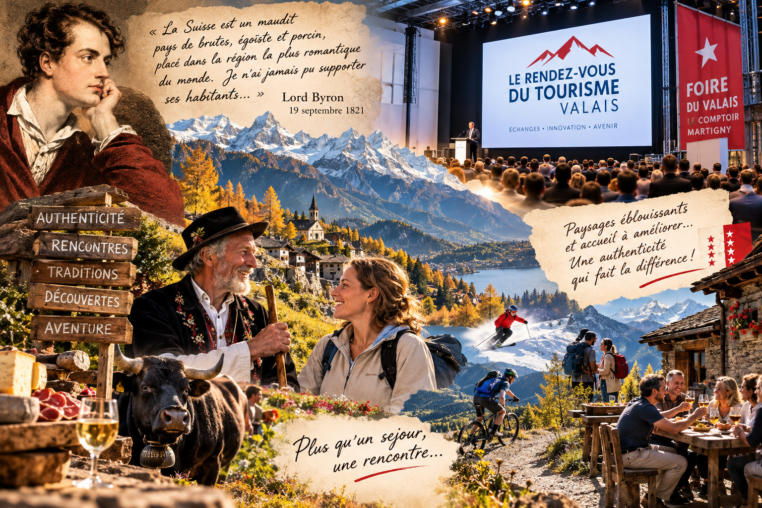
The event was “Le Rendez-Vous du Tourisme,” which brought together all the key players in the Valais tourism industry—more than 200 people—for a particularly packed morning.
The “news briefs” discussed here are just a small sample of the wide range of topics covered.
Authenticity and Roughness
In a letter to Thomas Moore dated September 19, 1821, Lord Byron wrote:
“Switzerland is a damned country of brutes—selfish and pig-like—situated in the most romantic region in the world. I’ve never been able to stand its people…”
And in a very Byronic contrast: he is deeply captivated by the Swiss landscapes but far less charmed by the Swiss people.
Yet Byron formed his impression of Switzerland largely through his journey through the Valais in 1816.
This “Rendez-Vous du Tourisme” event did not refute this caricatured view and even cited it. Everyone unanimously acknowledges the appeal of Valais through its dazzling mountain and valley landscapes, and there is the same unanimity—albeit more subtle—in recognizing that hospitality is an area that could use some improvement, even if those involved are not always aware of it.
Critics will point to the shortcomings of education from an early age, which should make future generations aware that tourism is theleadingemployer in Valais, providing 25,000 jobs, followed by manufacturing in second place with 15,000 jobs.
Yet if there is one “tourism” aspect that stands out as one of the main perceived assets of Valais, it isauthenticity. And in a virtualized world filled with (pre)fabricated images shaped by trends and social media, authenticity is a genuine quality that is becoming rare and highly sought after.
The tourist (translation:anyone who is not from Valais and whose family has not been native to the region for more than 6+ generations) is a guest whose duty is to adapt. However, they haven’t necessarily been raised to be humble and respectful of local traditions. The difference is that they come with money…
So why not come up with a way to inform or welcome our guests by letting them know that the Valaisans can come across as a bit rough around the edges—and that this is part of the authenticity they’re seeking—in order to clear up many misunderstandings? Better yet, why not develop an “adventure” tourism niche where, here, no one will “kiss up to you,” and you’ll have to adapt to time-honored traditions? Would this help revive family-run lodging, where visitors stay with a family rather than renting anonymous room and board? Will we be willing to “educate” tourists as much as we do tourism professionals? If the gap is too wide today, isn’t it possible for each of us to take a step toward one another?
Quality of the actors
Of course, all of this is only possible thanks to people who serve ascultural bridges, with a deep understanding of both their guests’ sensibilities and those of people who are deeply attached to their roots. It is at this cost that the “authentic” experience transcends that of mere scenic beauty or an escape from urban life, or that of an enriching escape—for it then transforms into cultural discovery, shared experiences, alternative ways of life, and encounters where tourism soon becomes a journey, a discovery, and a reflection.
But, you might ask, when I come here to enjoy sports (skiing, golf, biking) or more leisurely activities (walking or shopping…), how can I discover this authenticity and its treasures? One answer immediately comes to mind: join our local clubs, listen to what people have tosay, andgettoknow them; soak up the friendly atmosphere that helps you get to know us—it’s practically “included in the package”!
Culture and Tourism: Two Sides of the Same Coin
So “tourism” is also a matter of culture, given that “interaction” plays a major role in a successful experience.
Yes!
Demonstration:
This “Rendez-Vous du Tourisme” event reminded us that tourism owes a great deal to 19th-century Romanticism, moving away from the rationalism of the Enlightenment toward emotional experiences more closely tied to a “meaning of life.” Thus, the English of the Industrial Revolution found in our mountains adventures that were less distant than those overseas but just as thrilling, as they discovered what would become mountaineering and the conquest of mountain peaks. It is worth noting the iconoclastic nature of this movement, given that it began as a form of summer tourism. The cultural paradigm shift (emotion versus rationality) gave rise to tourism.
It is, therefore, deeply cultural, and while it has lost much of its “adventurous” aspect, it remains on the lookout for the experience that makes all the difference and adds value to even the briefest of stays.
Switzerland in general—and the Valais in particular—cannot compete on price in a globalized market. But it can enhance the value of the experience in a way that is not monetary and is, by its very nature, unique and inimitable.
Tourism and culture are like brother and sister; they are like two fingers on the same hand. Reducing either one to the sole dimension of a service or consumption is tantamount to destroying both. Shouldn’t we remember how many movies, TV series, or soap operas have helped boost the appeal of entire regions? How many works of art, museums, monuments, and festivals attract visitors—visits that sometimes turn into extended stays?
Tourists: An Unlimited Resource?
While tourism has its roots in a cultural approach that each civilization practices in its own way (the Green Guide for some, a smartphone for others…), and while it is becoming globalized and boosting the numbers for many destinations, some optimists are quick to extrapolate that it is an unlimited resource and that the tourist-customer is just waiting to be plucked like a rose in spring. Taking this logic to its extreme, we might be tempted to believe that even the most basic tourist infrastructure can find its audience…
Better yet, the high elevation of our mountains could be a powerful—if not the only—solution for recapturing the coolness of days gone by and escaping an urbanized lifestyle surrounded by air conditioners. That’s probably jumping to conclusions, though, because elevation also has a rival: latitude…
If tourists were an endlessly renewable resource, they would behave much like water. Water, a constant on our planet, is not the problem in and of itself; the problem is making it available where we need it. Tourists are much like water: they flow where they can easily find a path, but disappear at the slightest misaligned slope…
Here is a “roundup” of the various aspects discussed during this informative morning session, which was concluded by the president of the Valais Council of State, whose presence underscored the importance of a subject that is constantly evolving.
Jean
October 8, 2026